Algne artikkel on inglise keeles. Lehe navigeerimine on eestikeelne.
See artikkel ilmus algselt väljaandes Medium. Allolev link avab algse avaldamiskoha uuel vahelehel.
MediumDuring a recent conversation, a representative of a large corporation told me rather bluntly that the first jobs to disappear are the ones that should never have existed in their current form.
In other words: busywork.
Roles where people move information from one system to another, compile reports nobody really reads, or keep a process alive that should have been redesigned years ago.
Buckets under a leaking roof.
AI can now do more and more of that work.
Not because it solves the reason the roof is leaking. Most of the time, it does not. It finds information, fills in a spreadsheet, drafts a first proposal, answers a standard question, or moves the buckets faster.
But that is already enough to change the labour market.
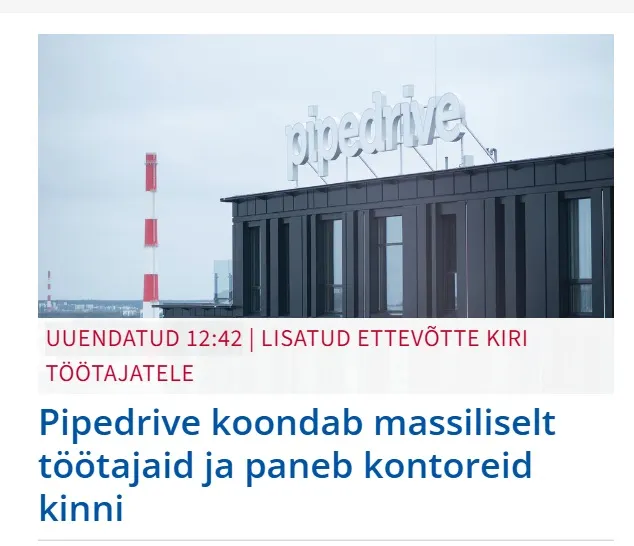
I do not think there is much value in overly careful wordplay around the latest announcements from Pipedrive and Swedbank.
The official explanations refer to restructuring, cost bases, product development and changing customer expectations. Yet AI is directly changing how software is bought and built, and how many people are needed to deliver the same amount of work.
We can debate whether AI wrote any particular redundancy notice or was only one of several reasons behind it.
From the perspective of the labour market, the distinction is not that large.
If AI makes it possible to achieve the same result with fewer people, it is part of the decision. Even when the press release calls it a “new operating model” or a “reorganisation of work.”
But where are the promised productivity gains?
AI evangelists have spent years talking about extraordinary productivity growth.
At the level of an individual worker, it is easy to see. AI can summarise a document, draft a first version, extract information from files or prepare a proposal. In some cases, the same task gets done faster.
But we should not confuse that with creating new value.
If a team of five can now do the work previously done by six, the company has reduced a cost. That does not automatically mean it sells more, builds a better product, finds new customers or brings additional export revenue into Estonia.
The broad economic effect has not arrived at the same pace.
In PwC’s 2026 global CEO survey, 56% of respondents said AI had not yet produced a significant financial benefit for their company. Only 12% said it had delivered both lower costs and higher revenue.
McKinsey’s latest survey tells a similarly mixed story. Eighty percent of respondents said AI had improved individual productivity, yet only 37% reported a positive effect on their organisation’s EBIT. Companies reporting both a significant impact and at least 5% EBIT impact accounted for only 6% of respondents.
So yes, AI already helps people work faster.
But the broad new value that should lead to more wages, more purchasing power, more exports and more tax revenue has not yet followed at the same scale.
That is the most dangerous part of this debate.
A profitable company can cut costs. But if the payroll money that disappears does not become new value and new income somewhere else, who takes out the next mortgage? Who buys a €1,500 smartphone? Who ultimately funds rising public costs?
New value still comes from people who build a better product, turn it into a brand, manufacture, install, maintain, sell, and give customers a real reason to pay.
AI can amplify that work.
But, at least for now, it does not do it for us.
The private sector will not simply absorb everyone
It would be convenient to believe that people who are laid off will simply find their next role in the private sector.
A manufacturer grows. A retailer opens another shop. A new startup appears. And eventually the market sorts itself out.
But this is exactly where Estonia has a problem.
We have real manufacturers making good products. Yet for some of them, it is becoming harder to sell through resellers when a cheaper private-label product imported from China offers a better margin.
We also have resellers trying to persuade customers to buy quality goods. At the same time, some purchasing power is moving towards cheaper imports, and businesses that worked well for years are having to close their doors.
This is not a judgment on every product made in China, or on every Estonian retailer.
The pressure is simply real.
Nor is the technology sector the place from which a quick rescue is likely to come.
Estonia has strong companies in fintech and cybersecurity. We have gaming, business tools, and Bolt. Defence technology is finally gaining momentum as well.
All of that matters.
But it is also a relatively narrow list.
Fintech. Cybersecurity. Gaming. A handful of business tools. And, in practice, one larger consumer-facing solution.
These are not bad fields. Quite the opposite.
But I do not currently see many early seeds from which a European Google, an Estonian SAP, or another company with a broad market and a large employer base could grow over the next decade.
The problem is not only that the next big companies emerge too slowly.
The problem is that, in today’s niches, there are not yet enough such growth seeds to place that hope on.
Startup Estonia’s latest detailed review points in the same direction: startup employment grew by only 1%, new registrations have declined since 2022, and investment in the first half of 2025 was 28% lower than a year earlier.
This does not mean that Estonia’s startup sector is dead.
It means it is not currently in a position to produce a new wave of hyper-scaling employers that can rapidly absorb people displaced by AI.
And we cannot solve that in six months.
That is the reality today.
We are not alone. But we do not have a strong fallback plan either.
This is a European problem.
Still, Italy can make beautiful clothes. France still produces remarkable wine. Germany still makes powerful cars. Spain is still a wonderful place to take a holiday.
Each of those countries has at least one globally recognisable thing for which the world is willing to pay well.
Beyond that, the water is in the stove.
European industry is under pressure. Consumer purchasing power is under pressure. The technology sector is under pressure. And now we must also answer what happens to people whose old tasks become cheaper for a machine to perform.
Finding Estonia’s next Nokia is, of course, an important question.
Fortunately, some smaller groups are thinking about it. I discussed the same question with a small group only yesterday, and we will continue next week.
But that is the larger and slower question.
This is not the time to wait for the next big growth story to solve everything.
Right now, we must seriously consider what happens to the people who used to move buckets of information around companies and whose work is now smaller or gone because of AI.
This should be the Estonian government’s number-one priority.
Code red.
Not the subject of the next strategy document.
Not another working group that publishes a polished PDF in a couple of years.
A fast national action plan.
In Estonia, unemployment was 6.6% in the second quarter of 2026. At the same time, there are fields with a real shortage of people. OSKA’s energy-sector study forecasts that the number of electricians and automation specialists will need to increase by nearly 1,400 by 2035, while comparable core occupations face an annual shortfall of more than 100 graduates.
So work has not disappeared.
Work and people may simply no longer meet in the same place.
The state should do at least three things now:
Map the jobs and tasks where AI is likely to reduce the need for people in the coming years. Not to create panic, but to identify who needs support before they have been out of work for a year.
Link retraining to real demand. Electricians and automation specialists are one example. Every programme should be designed together with employers, placements and actual job openings. We should not retrain people into the next dead end.
Change the education pipeline quickly. Vocational education, university curricula, adult learning and public procurement must start moving in the same direction. Some people do not need another five-year degree. They need a specific skill, a placement and a first employer willing to trust them.
The private sector cannot solve this alone.
One company cannot plan where an entire labour market will move. One school cannot expand places without a clear mandate. And one laid-off person cannot necessarily finance two years of retraining from savings while hoping that the right job exists at the end of it.
Meanwhile, public services are not going away. We will still need teachers, doctors, police officers and many others. But paying for their wages, infrastructure and services requires new value to be created in the economy.
Why an AI tax does not solve the problem
Taxes can patch budget holes in the short term.
But taxes do not create jobs by themselves. Nor do they make Estonian companies more productive.
The problem with an AI tax is even more specific.
If AI has not yet broadly created new revenue and new value, but mainly helps reduce the cost of routine work, there is no large new pool of value to tax.
We would be taxing the use of a tool, or the saving of a cost. Not a new product, a new customer or a new export market.
That will not fill the state budget while the need for unemployment benefits grows. It will not give a laid-off person a new skill or a new job.
We can debate an AI tax in the future, when automation produces genuinely large and concentrated new profits.
Today, it is mostly a convenient side issue.
The real question is how to create new value and how to move people towards the work where they are genuinely needed.
Simpler white-collar roles may not come back in the same form.
The ability to take responsibility, understand another person’s needs, make good choices, and actually get something done will only become more valuable.
Sales. Design. Production. Installation. Maintenance. Service.
And every other role where a person does not merely follow a process, but makes it better.
Difficult times.
But those are often the times that force the most meaningful positive change.
Good luck, and fast retraining.
Selle artikli pildid

Praktiline toote-, äri- ja AI juhtimine tegutsevate ettevõtete juhtidele. Agentkaubanduse töö OfferSignali kaudu.
Sanderist