Allikakirje: I02
Artikli väljaanne valmis: 4. november 2026. See ei ole kõigi viidatud allikate avaldamiskuupäev.
Uurimuse ajahorisont: 23 and 27 October 2026; source-specific dates retained in article
Algne artikkel on inglise keeles. Lehe navigeerimine on eestikeelne.
External-source research synthesis, not an OfferSignal client result. Based on the retained October 2026 research and source-specific dates.
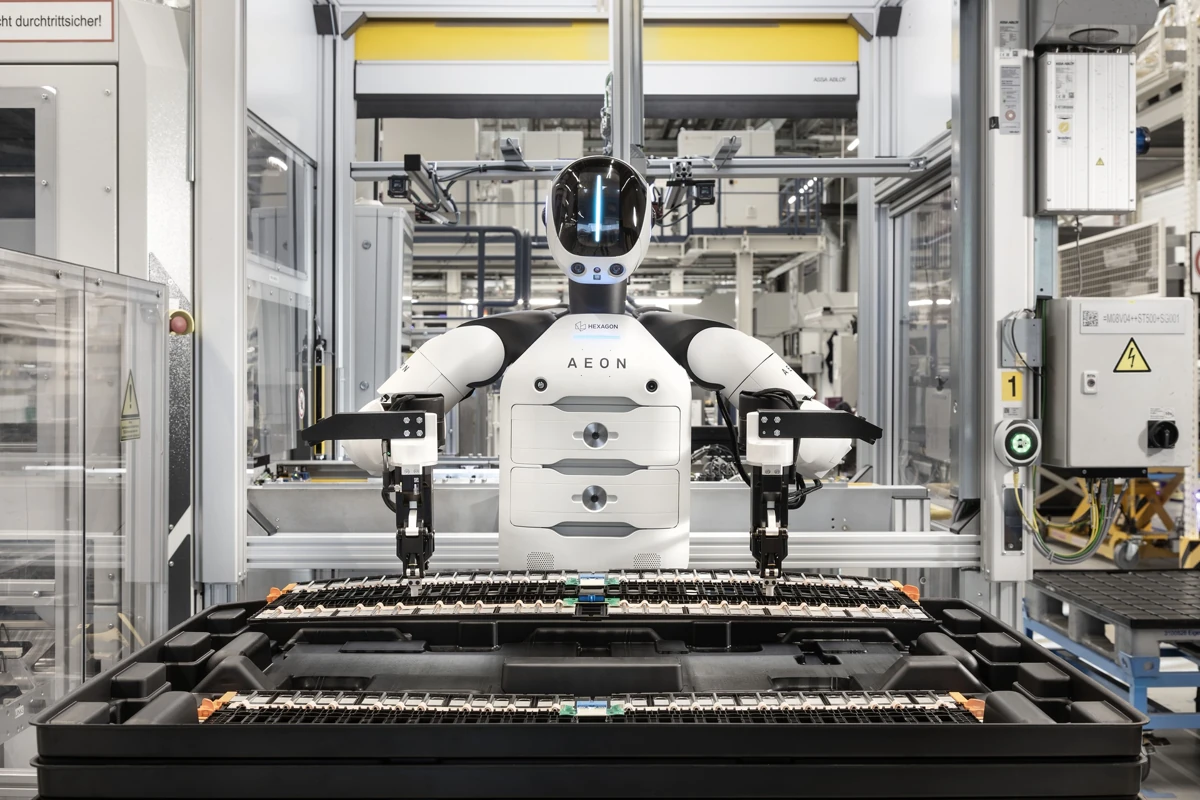
A factory can have repetitive, precise and ergonomically difficult work without having a safe, reliable way to automate every station. BMW’s Leipzig pilot addresses that gap with AEON, a humanoid robot from Hexagon Robotics, but the public evidence is narrower than the headline. It shows a staged industrial pilot and production-task activity; it does not yet prove routine high-voltage battery assembly at a named station.
What BMW and Hexagon are testing
BMW described a staged route from theoretical evaluation and laboratory work to an initial Leipzig test in December 2025, further testing from April 2026 and a pilot planned from summer 2026. The intended scope covers high-voltage battery assembly and component manufacturing, using a human-scale robot on wheels with interchangeable hands, grippers or scanning tools. 1
BMW’s later Leipzig feature describes AEON as 1.65 metres tall, weighing 60 kilograms and moving at up to 2.5 metres per second. It can deliver materials, navigate around obstacles and take on repetitive tasks; employees are involved in determining suitable uses, with the stated aim of supporting rather than replacing people. 2 Hexagon reported on 12 June 2026 that AEON had begun performing production tasks inside Plant Leipzig while being trained for future manufacturing applications. The same update said battery-assembly activity was expected to move from the Innovation Garage into the factory environment as a future pilot activity. 3
That wording matters. It supports production-task activity at Leipzig, but it does not identify a battery operation, part number, takt target, successful batch or stable series-production run. Public material names task families and a gradual move from energy-module battery production toward component manufacturing and workstation adaptation; it does not establish whether AEON performs connector seating, cable routing, fastening, inspection or another specific operation. 2 5
The evidence boundary is the practical lesson
No Leipzig cycle time, takt adherence, throughput, first-pass yield, defect rate, rework, availability, maintenance burden, energy use, labour-hours saved, ergonomic score or total-cost result is disclosed in the retained sources. BMW’s quantified robot result belongs to a separate 2025 Figure 02 pilot at Spartanburg in the United States: more than 30,000 BMW X3 vehicles, more than 90,000 components, approximately 1.2 million steps and approximately 1,250 operating hours over ten months, on ten-hour shifts five days per week. That work involved sheet-metal retrieval and positioning for welding, not AEON, Leipzig or battery assembly. 1 2
The Spartanburg figures are useful operating context, not a Leipzig benefit baseline. Likewise, BMW’s account of employee acceptance after early communication concerns Spartanburg. Hexagon’s cited public survey is not a Leipzig workforce sample. Employees being involved in use decisions is a process claim, not a measured approval rate or safety outcome. 2 3
German occupational-safety guidance says that a collaborative application must assess the robot, end effector and moved objects, while residual collision risk remains and protective measures are required. 5 For a mobile humanoid near high-voltage work, the buyer also needs evidence on electrical isolation, guarding, dropped parts, tool state, emergency recovery, access control and fire or thermal-event response. The EU Machinery Regulation becomes mandatory from 20 January 2027 and includes provisions relevant to AI-powered safety functions and cybersecurity; this is a future compliance checkpoint, not proof that AEON is currently compliant or non-compliant. 6
An illustrative manufacturer test
Consider an illustrative battery or electrical-component manufacturer evaluating a similar pilot. Start with one named operation, approved variants and a released work instruction. The production engineer and safety authority—not the robot or a language model—remain responsible for the task boundary, high-voltage conditions, interlocks and recovery. The system should receive versioned work-order, component, tool and workstation-state data, then record the unit, action, exception and quality result against the authoritative production record.
Test separated gates: successful task completion, cycle time against a human or existing-automation baseline, first-pass quality, intervention rate, recovery time, uptime, ergonomic effect and cost per productive hour. Include wrong variants, stale revisions, incompatible tools, missing electrical-state information and dropped-part scenarios. A unified production data model can support the workflow, but it does not guarantee a correct AI action; deterministic interlocks, traceability and human authority remain necessary. BMW’s Spartanburg experience suggests involving production IT, occupational safety, process management and shop-floor logistics early, but those lessons are not proof that Leipzig has passed the same controls. 1 2
Procurement before scale-out
Buying a humanoid means more than buying the body. The operating package includes end effectors and scanners, charging or battery-swap processes, layout and barriers, safety controls, manufacturing-system interfaces, network coverage, task-model versioning, quality capture, cybersecurity, training, spare parts and field service. Hexagon’s product page describes precision measurement, multimodal sensor fusion, three-dimensional spatial intelligence, AI-based motion control, dexterous hands and mobile locomotion. These are vendor capability claims, not BMW-specific performance results. 4
Commercial terms are undisclosed: there is no public purchase price, lease rate, software fee, service-level agreement, maintenance schedule or total-cost result. Hexagon said AEON would be deployed in production by the end of 2026, but that is a plan, not a completed scale-out decision. 3 The useful conclusion is therefore disciplined: BMW Leipzig is a credible feasibility and integration reference, not yet a public customer case proving autonomous high-voltage battery assembly, worker approval, productivity improvement or positive return on investment.
Sources and next reading
- BMW official Leipzig humanoid-robot feature
- BMW official pilot press release
- Hexagon Robotics AEON product page
- Hexagon Robotics BMW milestone update
- BMW PressClub AEON Leipzig video listing
- DGUV/IFA guidance on collaborative robots
- European Commission machinery legislation
- Independent Logistics Viewpoints context
Explore OfferSignal · Focused Business & AI Workshop · All research
References
- [1] BMW Group to deploy humanoid robots in production in Germany for the first time
- [2] BMW Group: First humanoid robot introduced in Plant Leipzig
- [3] New milestone with BMW Group: industrial humanoid deployment
- [4] AEON Multipurpose Industrial Humanoid Robot
- [5] Collaborative robots
- [6] Machinery - Internal Market, Industry, Entrepreneurship and SMEs
- [7] BMW: How Humanoid Robots Are Moving From Plant Trials Toward Production Work

Praktiline toote-, äri- ja AI juhtimine tegutsevate ettevõtete juhtidele. Agentkaubanduse töö OfferSignali kaudu.
Sanderist