Allikakirje: I18
Artikli väljaanne valmis: 4. november 2026. See ei ole kõigi viidatud allikate avaldamiskuupäev.
Uurimuse ajahorisont: 23 and 27 October 2026; source-specific dates retained in article
Algne artikkel on inglise keeles. Lehe navigeerimine on eestikeelne.
External-source research synthesis, not an OfferSignal client result. Based on the retained October 2026 research and source-specific dates.
Foundries often finish irregular castings by removing gates, risers and other pour-related material. The work is physically demanding and difficult to program when parts vary and stable computer-aided-design (CAD) files are unavailable. The question is whether a cell can scan the casting, let an operator identify the work area and generate a usable process path—not merely move a grinder.
What SFSA and its partners built
The Steel Founders’ Society of America (SFSA) championed Robotic Blending Milestone 5 inside the ROS-Industrial Consortium. The named team included Southwest Research Institute, Yaskawa America/Motoman, PushCorp, Iowa State University, Fisher Cast Steel, and in-kind partners ARIS Technology and Edison Welding Institute. Launched in 2023, the project aimed to deploy a working system at an SFSA member foundry and use perception rather than maintained CAD to finish casting surfaces for later inspection and shipment. [1] [8]
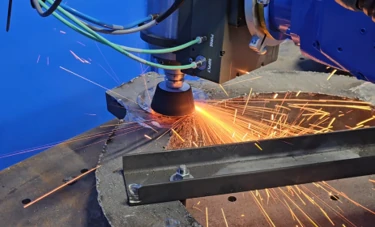
The workflow was scan, reconstruct, select a surface region, generate a tool path, plan robot motion and execute grinding. Public documentation describes a ROS 2 framework in which a depth camera scans the object, software reconstructs its surface, and planners create and execute the process path. The Fisher Cast Steel implementation identified a Motoman MH180 robot, Intel RealSense camera and raster-pattern grinding. [5] [7]
This was an integration and research project, not a turnkey product purchased by a producer. Fisher supplied casting samples; PushCorp contributed spindle and active-compliance guidance; Iowa State worked on segmentation and tool paths; Yaskawa integrated hardware; and Southwest Research Institute handled industrial-PC deployment, Docker images, calibration and initial testing. [1]
What the demonstration established
The project report says that by the middle of the second week at Fisher Cast Steel, the system was regularly grinding castings. At the 7 March 2024 shop-floor demonstration, it processed several features after an operator circled a region of interest in the graphical interface. Fisher then continued process improvements and trained operators to run the system independently. This is deployment and live-demonstration evidence at one named foundry, but it is a company-and-consortium report without an independent production log, published sample size or baseline. [1]
The same account records a material limitation: human-drawn boundary segmentation was not ready, so region selection remained manual. Reconstruction and planning were functional enough for the demonstration, but full automatic feature segmentation and all prior research transfer were unfinished. Later open-source work added simulation preview, collision representations, raster-planner controls, behavior-tree workflow logic, visualization and ROS 2 deployment support. These are engineering capabilities, not measured quality or productivity outcomes. [2]
No public result gives finished-surface tolerance, inspection pass rate, rework, scrap, cycle time, throughput, labour hours, consumables, safety incidents, uptime, cost or payback. The number of castings, features, shifts, operators and production orders is also unpublished. A successful demonstration must not therefore be described as proven quality improvement or reduced rework.
Keep related evidence separate
Edison Welding Institute describes a broader SFSA foundry-automation programme and a separate semi-automatic blend-grinding prototype using a UR10, handheld-grinder end effector, force feedback, a simple interface, pendant-entered material removal and laser measurement on three casting geometries. That corroborates the automation context, but the retained evidence does not establish that this UR10 prototype was the Fisher Cast Steel Milestone 5 cell. The evidence tracks should not be merged. [4]
An illustrative European pilot
The transferable idea is an operator-authorised scan-and-plan cell for high-mix, CAD-poor castings—not equivalent performance. An illustrative pilot could select one robot, camera, spindle and grinding-media combination, then record part family, alloy, region to remove, target tolerance, inspection method, intervention and recovery rules. The process owner should approve the selected region and finished part; safety and quality owners should approve the cell and acceptance criteria.
Compare the cell with the current manual baseline using a defined casting set. Measure cycle time, labour, tolerance, pass rate, rework, scrap, uptime and consumables, while recording failures and operator interventions. Keep a workable technical path separate from a quotation, purchase order or production release. The US result is a feasibility and integration precedent, not evidence of European production performance or a commercial offer.
The software is publicly available under Apache License 2.0, but no public software, integration or support price, service-level agreement, industrial certification or guaranteed maintenance commitment is disclosed. The practical model is open-source code plus site-specific robot, tooling, calibration, safety, process-development, training and acceptance work. The 2025 documentation refresh improves developer access, with stated Ubuntu Humble and Jazzy support and Rolling marked unsupported; it does not create a quantified customer case. [3] [5] [6] [7]
Sources and next reading
Explore OfferSignal · Focused Business & AI Workshop · All research
References
[1]: https://rosindustrial.org/news/2024/5/17/robotic-blending-milestone-5-wraps-up-on-the-foundry-shop-floor "Robotic Blending Milestone 5 Wraps Up on the Foundry Shop Floor" (ROS-Industrial, 17 May 2024).
[2]: https://rosindustrial.org/news/2024/4/12/open-source-improvements-from-recently-completed-robotic-blending-m5 "Open Source Improvements from Recently Completed Robotic Blending M5" (ROS-Industrial, 12 April 2024).
[3]: https://rosindustrial.org/news/2025/11/24/scan-n-plan-workshop-documentation-refresh "Scan-N-Plan Workshop Documentation Refresh" (ROS-Industrial, 24 November 2025).
[4]: https://ewi.org/automated-solutions-to-improve-foundry-processes/ "Automated Solutions to Improve Foundry Processes" (EWI, 20 November 2023).
[5]: https://ros-industrial-consortium.github.io/scan_n_plan_workshop/index.html "Scan-N-Plan Workshop Documentation" (ROS-Industrial Consortium, public documentation; accessed by cutoff 27 October 2026).
[6]: https://raw.githubusercontent.com/ros-industrial-consortium/scan_n_plan_workshop/master/LICENSE "scan_n_plan_workshop Apache License 2.0" (public repository license; accessed by cutoff 27 October 2026).
[7]: https://github.com/ros-industrial-consortium/snp_blending "ros-industrial-consortium/snp_blending" (public Milestone 5 implementation repository; accessed by cutoff 27 October 2026).
[8]: https://rosindustrial.org/news/2023/5/5/ros-industrial-focused-technical-project-robotic-blending-milestone-5-launches "ROS-Industrial Focused Technical Project Robotic Blending Milestone 5 Launches" (ROS-Industrial, 5 May 2023).
[9]: https://www.youtube.com/watch?v=ZXxll0hqFuE "Robotic Blending Milestone 5 - Highlight Video" (ROS-I Consortium, published 2 December 2024; public video page).
- [1] Robotic Blending Milestone 5 Wraps Up on the Foundry Shop Floor
- [2] Open Source Improvements from Recently Completed Robotic Blending M5
- [3] Scan-N-Plan Workshop Documentation Refresh
- [4] Automated Solutions to Improve Foundry Processes
- [5] Scan-N-Plan Workshop Documentation
- [6] scan_n_plan_workshop Apache License 2.0
- [7] ros-industrial-consortium/snp_blending
- [8] ROS-Industrial Focused Technical Project Robotic Blending Milestone 5 Launches
- [9] Robotic Blending Milestone 5 - Highlight Video

Praktiline toote-, äri- ja AI juhtimine tegutsevate ettevõtete juhtidele. Agentkaubanduse töö OfferSignali kaudu.
Sanderist