
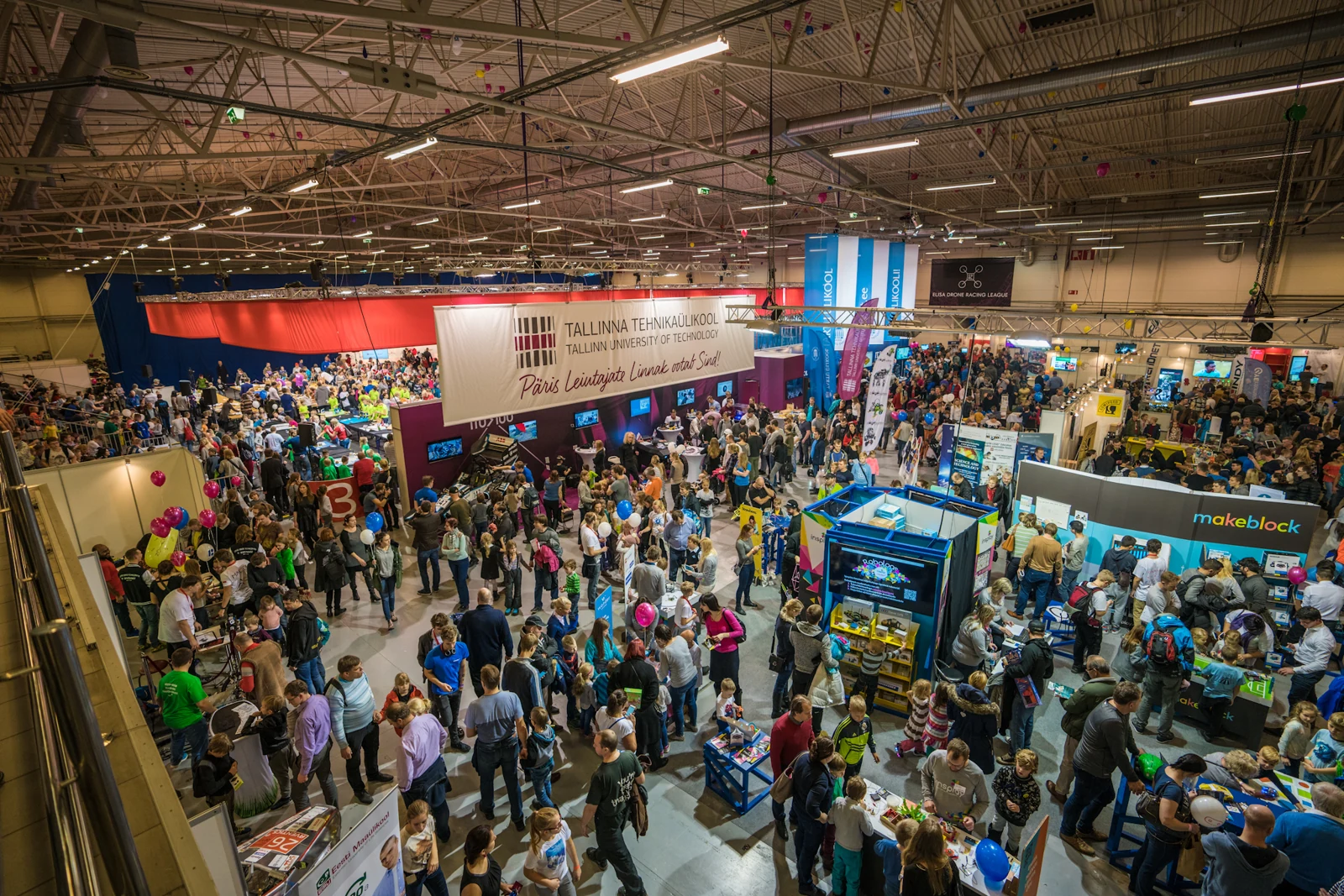
In 2017, Ave Laas invited me to join Robotex as Chief International Officer. I agreed to help for three to six months, developing relationships with businesses, universities and robotics teams that could join our Tallinn festival. I wanted to learn more about robotics and was happy to travel. Working alongside Ave, our CEO, I ended up staying much longer. That year, we welcomed 27,000 people to the full festival.
Over the next two years, we built an international network and expanded the Tallinn festival. Our 2018 conference brought together 942 attendees. I also wanted Robotex to help more technical teams build businesses, and that ambition became my reason for staying. By January 2019, I had realised how difficult it was for the same team to pursue both robotics education and startup development. We chose to focus on education, and I moved out of day-to-day operations.
At our Tallinn festival in 2017
I helped organise the festival, which included competitions, an exhibition, workshops and a conference. The 942 attendees at our 2018 conference were a separate count.
In our international network by January 2019
Local organisers helped us expand. By the end of 2018, events had taken place in Estonia, Cyprus, China, Colombia and India. Other teams were preparing their local activities.
At our 25 Tallinn robotics competitions in 2018
Competitors came from 44 countries, with 43% joining us from abroad. I worked on international participation alongside the coordinators and team who ran the competitions.
Joined us for the 2018 event
I contacted around 500–600 potential partners and sent more than 3,000 emails, including follow-ups. Around 70 joined us. I also had to change prices and benefits during the sales process.
How the work developed
- April 2017
Joining Robotex
Ave invited me to help develop international relationships. After several meetings, I agreed to work on cooperation with businesses, universities and robotics organisations.
- November 2017
Expanding the Tallinn festival
We welcomed 27,000 people, including 3,052 competitors. I helped organise the festival, with its competitions, exhibition, workshops and our first standalone two-day technology conference.
- May 2018
Plans for a wider community
As Chairman, I spoke about our education, festival and innovation programmes. I wanted early robotics experience to lead to more advanced projects and eventually businesses. The scale of startup creation I proposed was still an ambition.
- November–December 2018
The international festival and conference
We developed the conference alongside our competitions and expo. It welcomed 942 attendees and 80 speakers. At the expo, 49 companies from six countries exhibited, while 2,406 competitors took part in the robotics competitions.
- January 2019
Moving to an advisory role
We decided to focus on robotics education, and I stepped away from day-to-day operations. I stayed involved as an advisor, helping with strategy and introductions and discussing ideas with Ave and our local and international teams.
An international network
Robotex had been supporting robotics education in Estonia since 2001. I joined an organisation built through years of work by universities, students and many others. My job was to make the festival better known internationally and get more organisations involved.
I started by meeting robotics clubs and technology companies at events they already attended. I got to know the people involved, explained what we were doing in Tallinn and explored whether they wanted to join us. After the first few months, I drafted a plan for a global robotics community. Local partners would run Robotex in their own countries under a licence model, giving us a way to grow beyond one annual festival.
I wanted that network to help technical teams start businesses too. Children could get their first experience of robotics, then take on more advanced challenges as they grew older. Teams with projects could get feedback, find mentors and eventually meet potential investors. I saw a chance to support that whole process, though we had yet to show how many businesses it would produce.
Festivals and partnerships
I worked on international promotion and partnerships, and helped organise the Tallinn festivals. We made English the main language of the international festival and our marketing, and brought more international organisations into our partner network and expo. I attended the first overseas Robotex events in Cyprus, China, Colombia and India. The local organisers knew their communities and did the work of running those events.
Competitions stayed at the centre of the festival. In 2017, we added a standalone two-day technology conference and worked with partners to offer 58 workshop formats across 118 sessions, attended by 1,900 people. I wanted visitors to have a chance to try the technology themselves. We also introduced entrepreneurship and innovation challenges where teams could show prototypes, get feedback and work on problems put forward by businesses.
For the 2018 event, I rebuilt our sponsorship materials. We split prospects into local and international companies, found the relevant marketing and HR contacts, and used a CRM to keep track of follow-ups. I made the offer clearer about booth space, passes and visibility, with optional activities for partners who wanted more. I removed promises that would take too much work to deliver, but still had to adjust prices and benefits while selling. I had set them without properly testing what companies were willing to pay.
Results
By January 2019, our network covered 15 markets. Events had taken place in Cyprus, China, Colombia, India and Estonia, with other local teams preparing theirs. I was pleased to see people taking Robotex into their own communities. Ave, our competition coordinators, partners and international teams all helped make that possible.
Our 2017 Tallinn festival welcomed 27,000 people, including 3,052 competitors. In 2018, we had 2,406 competitors from 44 countries. The conference brought together 942 attendees from 54 countries and 80 speakers, while 49 companies from six countries exhibited at the expo. Cleveron used our stage to announce a new concept vehicle. We had families trying technology, teams competing and companies meeting potential partners at the same festival. They each needed a different reason to come and a programme that suited them.
For the 2018 event, I sent more than 3,000 emails, including follow-ups to around 500–600 distinct prospects. Around 70 partners joined us. Those conversations helped me understand why companies participated. Some wanted to meet potential employees, others wanted visibility or somewhere to introduce a product. I learned to build the offer around those interests rather than give everyone the same logo placement.
Mistakes and lessons
I assumed we could turn a recognised educational festival into an organisation that also developed startups. People already knew what Robotex stood for, and my attempts to broaden it had started to confuse them. Our core team could not pursue both goals at once either. We chose to concentrate on education. Since the innovation work had been my reason for staying, it made sense for me to leave the operational role.
In 2018, we introduced competition fees and raised visitor ticket prices. We ended up with 15% fewer festival visitors and lost some long-standing local partners. I believed we had improved the event and the standard of competition, but the local organisation had not grown as I had hoped. I also learned from having to change the sponsorship offer while selling it. I had priced the packages around our funding needs before checking whether the benefits justified those prices to buyers.
The 2017 feedback gave us plenty of practical work to do. We needed a clearer conference audience, earlier communication and better workshop registration. Noise was a problem too. Competition information systems, judge preparation and volunteer training all needed attention. I was spending much of my time bringing people in; we also had to make sure they could find the right information, get into the activities they wanted and have a good experience once they arrived.
Lessons I still use
I became more careful about asking an existing team to take on a new direction. At Robotex, robotics education and startup development sounded close enough to combine, but they required different work and confused the audience when we tried to pursue both. I learned to consider how a new ambition would affect the people already doing the work and those who relied on the organisation.
I also learned to discuss an offer with potential buyers before committing to a large outreach campaign. For a festival partner, the details mattered: who would attend, where the booth would be, which activities they could join and how much work it would take our team to provide them. Those conversations would have helped me set better prices and avoid rewriting parts of the offer after the emails had gone out.
More from the journey