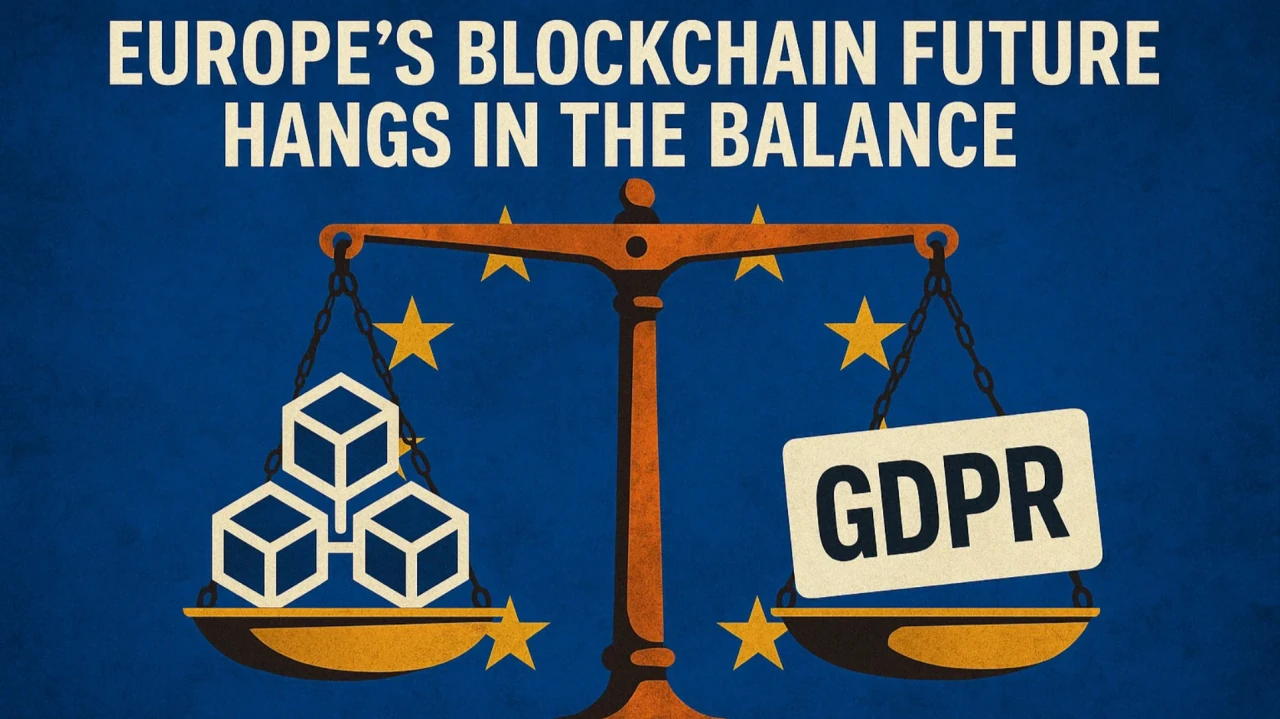
In the race to harness blockchain's transformative potential, three global powers have emerged with distinct approaches: the United States drives innovation with minimal constraints, China strategically adapts technology while maintaining control, and Europe focuses on comprehensive regulation. This dynamic—often summarised as "USA innovates, China replicates, Europe regulates"—has profound implications for the future of blockchain technology and Europe's place in the digital economy.
The European Data Protection Board (EDPB) recently released guidelines to align blockchain technology with the General Data Protection Regulation (GDPR), aiming to safeguard personal data in an increasingly digital landscape. While protecting privacy is undoubtedly crucial, these guidelines impose restrictive measures that threaten to undermine the very qualities that make blockchain valuable: open system connectivity and reduced bureaucratic overhead. By favouring permissioned blockchains, imposing traditional data protection roles on decentralised systems, and taking a rigid approach to data minimisation, the EDPB risks hindering Europe's ability to compete globally in blockchain innovation.
This article critiques the EDPB's approach, highlighting how it hampers blockchain's potential in Europe, examines the cautionary tale of Tradelens (a failed permissioned blockchain initiative), analyses Europe's competitive standing in the global blockchain landscape, and proposes a more effective alternative that preserves GDPR compliance while allowing blockchain technology to flourish.
The EDPB Guidelines: A Barrier to Innovation and Openness?
The EDPB guidelines emphasise permissioned blockchains, minimal on-chain data storage, and rigid role definitions to ensure GDPR compliance. While these measures aim to enhance privacy, they inadvertently undermine the qualities that make public blockchains valuable: seamless system connectivity and reduced bureaucratic overhead.
Constraining the Openness of System Connectivity
Public blockchains thrive on their ability to connect systems and participants globally without gatekeepers. This openness enables interoperability, allowing diverse applications—such as cross-border payments, supply chain tracking, and digital identity platforms—to integrate seamlessly. However, the EDPB's preference for permissioned blockchains, which limit participation to authorised entities, restricts this connectivity.
The guidelines state that "organisations should favour permissioned blockchains" and that they "should only explore different blockchain governance alternatives if well-justified and documented reasons hinder this preference." This prescriptive approach creates silos that hinder the free flow of data and collaboration across systems, stifling the innovation that arises from an open ecosystem. For example, a public blockchain enabling real-time global trade could be forced into a closed, less efficient model, reducing its practical utility and competitive advantage.
Eroding Trustlessness and Reintroducing Bureaucracy
A key advantage of public blockchains is their trustless nature, where transactions and processes occur without reliance on cumbersome intermediaries or excessive administration. This efficiency drives applications like smart contracts, which automate agreements with minimal oversight. The EDPB guidelines, however, impose strict roles— such as data controllers and processors—that reintroduce bureaucratic structures.'
The guidelines state that "the decentralised governance model used by blockchain leads to a multiplicity of actors and roles involved in the processing. However, neither this fact nor the selection of a particular technical infrastructure can be used as a reason not to comply with the GDPR." While compliance is necessary, assigning traditional GDPR roles in a system designed to operate without centralised control adds complexity and costs, undermining the streamlined operations that public blockchains promise.
Rigid Approach to Data Minimisation and Immutability
The EDPB guidelines take a particularly strict stance on data storage, stating that "in general, it is not advisable to store personal data on the blockchain, and it should not be stored in the content of transactions." This approach fails to recognise the advances in privacy-enhancing technologies that can enable GDPR-compliant data handling on public blockchains.
Furthermore, the guidelines acknowledge the immutability challenge—"storing personal data in a directly identifying form on a blockchain has several implications. First of all, once stored on a blockchain, the data will stay on the blockchain with no practical possibility of deletion or modification in most cases"—but offer limited flexibility in addressing it, primarily suggesting off-chain storage or encryption, which can reduce blockchain's utility.
Economic Risks for Europe
By limiting openness and efficiency, the EDPB guidelines could push blockchain development to regions with more accommodating regulations. This risks diminishing Europe's role in a technology poised to transform industries, leading to lost opportunities in economic growth, job creation, and technological leadership.
As noted in recent research, "Today, only 3 per cent of global AI unicorns come from the EU, while private investment in AI is 14 times higher in the United States and 5 times higher in China." A similar pattern could emerge in blockchain if Europe's regulatory approach remains overly restrictive, further widening the innovation gap.
The Cautionary Tale of Tradelens: Permissioned Systems Aren't a Panacea
The EDPB's preference for permissioned blockchains assumes that such systems offer a superior solution for GDPR compliance. However, the failure of Tradelens—a high-profile permissioned blockchain initiative by shipping giant Maersk and technology leader IBM —offers a cautionary tale that challenges this assumption.
Launched in 2018, Tradelens was designed to revolutionise global shipping by creating a blockchain-based platform for supply chain management. Despite significant investment and backing from industry leaders, Maersk and IBM announced in November 2022 that they would discontinue the platform after failing to reach "commercial viability necessary to continue work and meet financial expectations."
Why Tradelens Failed Despite Significant Investment
Tradelens' failure stemmed from several interconnected factors that highlight the inherent limitations of permissioned blockchain systems:
- Technology Limitations: The platform was reportedly too slow, expensive, and lacked the necessary scalability for the logistics industry's demands. These limitations are common in permissioned blockchains, which often sacrifice performance for control.
- Integration Complexity: Integrating Tradelens with existing legacy systems proved difficult and complex for participants. This challenge is particularly relevant to the EDPB guidelines, which would require similar integration efforts for GDPR compliance.
- High Costs: Significant upfront implementation costs made the platform inaccessible for many smaller and medium-sized enterprises, limiting widespread adoption. This contradicts the EDPB's goal of ensuring data protection for all data subjects, as only large organisations could afford to participate.
- Lack of Trust & Competition Concerns: The platform was operated by Maersk, a major player in the shipping industry. Potential participants (competitors of Maersk) were hesitant to share sensitive data on a platform controlled by a competitor. This trust issue is fundamental to permissioned blockchains, where control is centralised.
- Centralised Control Model: Although using blockchain, the platform was based on IBM's private, permissioned Hyperledger Fabric and effectively controlled by Maersk. This centralised governance model clashed with the need for a neutral, open platform in the fragmented logistics sector and discouraged collaboration.
As noted in an analysis of Tradelens' failure, "wariness of interacting with Tradelens was likely compounded by the fact that the network was effectively owned, managed, and operated by Maersk, a company that many entities in the logistics industry consider a major competitor. This factor alone likely dissuaded even those who were open to the idea of a blockchain-based solution."
Implications for the EDPB Guidelines
The Tradelens case demonstrates that simply mandating permissioned blockchains, as the EDPB guidelines effectively do, does not guarantee success or widespread adoption. In fact, it may introduce new problems:
- Trust Paradox: Permissioned blockchains require participants to trust the controlling entities—precisely what blockchain technology was designed to eliminate. The EDPB guidelines, by favouring permissioned systems, reintroduce this trust requirement.
- Economic Viability Challenges: As Tradelens showed, permissioned blockchains can struggle to achieve commercial viability, even with significant backing. By pushing European organisations toward this model, the EDPB may be setting them up for similar failures.
- Limited Network Effects: Permissioned blockchains inherently limit participation, reducing the network effects that drive value in blockchain ecosystems. This limitation could prevent European blockchain initiatives from reaching critical mass.
- Innovation Constraints: The controlled nature of permissioned blockchains can stifle the innovation that flourishes in open systems. By restricting European blockchain development to permissioned models, the EDPB risks limiting the region's innovative potential.
The Tradelens example serves as a powerful reminder that regulatory preferences should be informed by practical realities. While permissioned blockchains may seem to offer easier GDPR compliance on paper, they come with significant drawbacks that can undermine their effectiveness and adoption in practice.
Europe's Competitive Standing in the Global Blockchain Race
The global blockchain landscape is characterised by distinct regional approaches that reflect broader technological strategies. Understanding these differences is crucial for assessing how the EDPB guidelines might impact Europe's competitive position.
The Global Landscape: Three Distinct Approaches
The United States: Innovation-First Approach
The US has adopted a largely pro-innovation stance toward blockchain technology. As noted in a recent Atlantic Council analysis, "The new Trump administration has spoken decisively... The United States now charts a pro-blockchain, anti-CBDC policy trajectory on the grounds that CBDCs 'threaten the stability of the financial system individual privacy, and the sovereignty of the United States.' It also asserts that 'lawful and legitimate' stablecoins support the 'sovereignty of the United States dollar.'"
This approach prioritises market-driven development and competitive advantage, with regulatory clarity emerging gradually through court decisions, legislative actions, and regulatory guidance. The focus remains on fostering innovation while addressing specific risks as they arise, rather than imposing comprehensive preemptive frameworks.
China: Strategic Control with Technological Advancement
China has taken a dual-track approach: strictly controlling cryptocurrency trading and mining while heavily investing in blockchain technology and developing a central bank digital currency (CBDC). As one analysis notes, "Despite the regulatory restrictions, China's blockchain sector remains robust and influential. The government is clearly focused on managing the technology's development rather than stifling it entirely."
This strategy allows China to harness blockchain's technological benefits while maintaining state control over financial flows and data—a balance that has enabled significant advancement in areas like supply chain management, digital identity, and government services.
Europe: Regulation-First Approach
Europe has prioritised comprehensive regulation, exemplified by the Markets in CryptoAssets Regulation (MiCAR) and the EDPB guidelines on blockchain and GDPR. As the Atlantic Council observes, "When the European Union's (EU) digital currency regulation (MiCAR) went into effect on December 30, 2024, the EU's regulatory pillars for crypto asset oversight were completed. Together with the Transfer of Funds Regulation and the Digital Operational Resilience Act, MiCAR extends bank-like rules to stablecoins and cryptocurrencies."
This approach aims to provide legal certainty and protect consumers, but risks creating a restrictive environment that could hamper innovation and adoption. The phrase "USA innovates, China replicates, Europe regulates" captures this dynamic, highlighting Europe's tendency to prioritise regulatory frameworks over technological experimentation.
How the EDPB Guidelines Could Disadvantage Europe
The EDPB's restrictive approach to blockchain and GDPR compliance could further disadvantage Europe in several ways:
1. Driving Talent and Investment Elsewhere
Blockchain developers, entrepreneurs, and investors are highly mobile and tend to gravitate toward jurisdictions with favourable regulatory environments. The EDPB guidelines, by imposing additional constraints on blockchain development in Europe, could accelerate the exodus of talent and capital to more accommodating regions.
This concern is particularly acute given Europe's already lagging position in blockchain investment. As noted in the context of AI (which faces similar regulatory challenges), "Today, only 3 per cent of global AI unicorns come from the EU, while private investment in AI is 14 times higher in the United States and 5 times higher in China." A similar pattern is emerging in the blockchain sector, where European investment lags significantly behind that of the US and Asia.
2. Isolating European Blockchain Ecosystems
The EDPB's preference for permissioned blockchains could isolate European blockchain initiatives from the global ecosystem, which is increasingly built on public blockchain infrastructure. This isolation could limit interoperability, reduce network effects, and ultimately diminish the value and utility of European blockchain applications.
As the Atlantic Council analysis highlights, "US crypto issuers and intermediaries currently dominate EU markets... USD-based stablecoins constitute 90 per cent of market capitalisation and over 70 per cent of trading volume in Europe." The EDPB guidelines could exacerbate this dominance by making it harder for European alternatives to emerge and compete.
3. Slowing Adoption in Key Industries
Industries such as finance, supply chain, healthcare, and energy are poised to benefit significantly from blockchain technology. However, the additional compliance burden imposed by the EDPB guidelines could slow adoption in these sectors within Europe, allowing competitors in other regions to gain first-mover advantages.
The Tradelens example demonstrates how even well-funded initiatives can fail when faced with adoption challenges. The EDPB guidelines, by adding further complexity and constraints, could make it even more challenging for European blockchain projects to achieve the critical mass necessary for success.
4. Creating Regulatory Arbitrage Opportunities
The divergence between Europe's strict approach and the more flexible stances in other regions creates opportunities for regulatory arbitrage. Companies may establish minimal presences in Europe while conducting most of their operations from more favourable jurisdictions, limiting the economic benefits that Europe derives from blockchain innovation.
This dynamic is already visible in the crypto industry, where many companies maintain European operations for market access but base their primary development and investment activities elsewhere.
The Economic Stakes for Europe
The economic implications of falling behind in blockchain innovation are substantial. Blockchain technology is expected to create significant value across multiple sectors, from financial services to supply chain management, healthcare, energy, and government services.
By adopting an overly restrictive approach to blockchain and GDPR compliance, Europe risks:
- Missing out on job creation in high-value technology sectors
- Losing tax revenue from blockchain-based businesses
- Reducing the efficiency and competitiveness of European industries that could benefit from blockchain adoption
- Diminishing Europe's influence in setting global standards for blockchain technology
As blockchain technology continues to mature and integrate with other emerging technologies like AI, IoT, and 5G, the costs of regulatory barriers will only increase. Europe must find a way to balance legitimate privacy concerns with the need to foster innovation and maintain global competitiveness.
Charting a Better Course: Balancing GDPR Compliance and Innovation
Europe can adopt a more balanced approach that upholds GDPR's privacy principles while fostering blockchain innovation. Rather than constraining public blockchains, regulators can leverage technology and flexible policies to preserve system connectivity and operational efficiency. Here's how:
1. Embrace Privacy-Enhancing Technologies (PETs)
Privacy-enhancing technologies offer a way to protect data without sacrificing the openness and efficiency of public blockchains. These technologies can enable GDPR compliance while preserving blockchain's core strengths:
Zero-Knowledge Proofs (ZKPs) allow systems to verify transactions or identities without revealing sensitive details. For example, a ZKP could prove that a person is over 18 without disclosing their actual birthdate, maintaining connectivity across platforms while meeting GDPR's data minimisation requirements. Projects like Zcash and applications in Ethereum demonstrate that ZKPs can be implemented at scale.
Secure Multi-Party Computation (MPC) enables multiple parties to jointly compute a function over their inputs while keeping those inputs private. This technology could allow data processing across organisational boundaries without exposing personal data, addressing GDPR concerns while enabling collaborative applications.
Homomorphic Encryption permits computations on encrypted data without decrypting it first. This could allow personal data to be stored on a blockchain in encrypted form, with only authorised parties able to access the information, aligning with GDPR's security requirements.
By promoting these technologies, regulators can enable public blockchains to remain accessible and interoperable while ensuring privacy. Rather than mandating permissioned systems, the EDPB could encourage the use of PETs as a means of achieving GDPR compliance in public blockchain contexts.
2. Implement Adaptive Regulatory Frameworks
A rigid, one-size-fits-all approach does not suit the blockchain's dynamic nature. More flexible regulatory mechanisms could foster innovation while maintaining privacy safeguards:
Regulatory Sandboxes could allow blockchain projects to test GDPR-compliant solutions in real-world scenarios under regulatory supervision. This approach has been successful in fintech and could be extended to blockchain, enabling innovation while refining privacy practices. The UK, Singapore, and Switzerland have implemented such sandboxes with positive results.
Risk-Based Approaches would tailor regulatory requirements to the actual privacy risks involved, rather than imposing blanket restrictions. For instance, blockchain applications handling non-sensitive data or pseudonymised information could face lighter requirements than those processing sensitive personal data.
Decentralised Accountability Models could replace traditional controller/processor designations with frameworks better suited to blockchain's distributed nature. For example, smart contracts could encode compliance requirements and automatically enforce them, distributing responsibility across the network while ensuring accountability.
These adaptive frameworks would preserve trustlessness by avoiding unnecessary bureaucracy, keeping systems efficient and scalable while addressing legitimate privacy concerns.
3. Set Goals, Not Mandates
The EDPB's prescriptive rules, such as favouring permissioned systems, limit technological flexibility. A smarter approach would define clear privacy objectives while leaving implementation to developers:
Outcome-Based Regulation would specify privacy goals (such as data minimisation, security, or the right to erasure) without mandating specific technical approaches. This would encourage creative solutions that maintain open connectivity and minimal administration.
Technology-Neutral Standards would focus on what needs to be achieved rather than how it should be done. For example, instead of requiring off-chain storage, regulations could require that personal data be protected with appropriate technical measures, allowing for various implementations, including on-chain encryption or hashing.
Interoperability Requirements would ensure that European blockchain systems can connect with global networks while maintaining privacy standards. This would prevent the isolation of European blockchain ecosystems and enable participation in the global digital economy.
This goal-oriented approach would align the GDPR with blockchain's strengths, rather than opposing them, thereby fostering innovation while protecting privacy.
4. Promote International Coordination
Given the global nature of blockchain technology, Europe should work toward international coordination on privacy standards:
Mutual Recognition Frameworks could acknowledge equivalent privacy protections in other jurisdictions, facilitating cross-border data flows and blockchain operations. This would be particularly valuable for European companies operating in global markets.
Global Standards Development would involve Europe actively participating in international blockchain standards bodies, ensuring that privacy considerations are integrated into technical standards from the outset rather than imposed retroactively.
Bilateral Agreements with key partners like the United States could address specific blockchain use cases and establish common approaches to privacy protection, reducing regulatory friction and compliance costs.
By engaging internationally, Europe can influence global blockchain development while creating a more favourable environment for its own blockchain ecosystem.
5. Support Research and Education
To build a sustainable blockchain ecosystem that respects privacy, Europe should invest in:
Research Funding for privacy-enhancing technologies and their applications in blockchain contexts. This would help develop technical solutions to GDPR compliance challenges and position Europe as a leader in privacy-preserving blockchain technology.
Educational Programs to build expertise in both blockchain technology and data protection. This would address the skills gap that currently hampers blockchain adoption and compliance efforts.
Public-Private Partnerships to develop reference implementations and best practices for GDPR-compliant blockchain applications. These could serve as models for the industry and reduce compliance uncertainty.
Through these investments, Europe could develop the knowledge and tools needed to lead in privacy-preserving blockchain innovation rather than merely regulating it.
Conclusion: Unlocking Blockchain's Future in Europe
The European Data Protection Board's guidelines on blockchain and GDPR, while driven by the essential goal of protecting personal data, risk undermining the very innovation they seek to regulate. By favoring restrictive permissioned models, imposing traditional roles on decentralised systems, and adopting a rigid stance on data minimisation and immutability, the guidelines inadvertently create barriers that could hinder Europe's ability to compete in the global blockchain race against innovationfocused regions like the United States and strategically-driven China.
The cautionary tale of Tradelens highlights the practical limitations and potential for failure inherent in permissioned blockchain systems, demonstrating that they are not a guaranteed solution for complex industries and may struggle with adoption due to trust, cost, and scalability issues. Pushing European innovation primarily towards this model could prove economically detrimental.
Europe stands at a critical juncture. It can continue down the path of regulation-first, potentially stifling its burgeoning blockchain ecosystem and ceding leadership to other regions. Or, it can adopt a smarter, more balanced approach. By embracing privacy-enhancing technologies like zero-knowledge proofs, implementing adaptive and technology-neutral regulatory frameworks such as sandboxes and outcome-based goals, promoting international coordination, and investing in research and education, Europe can harmonise GDPR compliance with blockchain's transformative potential.
This balanced strategy would not only safeguard citizens' privacy but also position Europe as a hub for innovative, interconnected, and efficient blockchain systems. It would allow the continent to leverage blockchain's strengths—openness, efficiency, and trustlessness—to drive economic growth, create high-value jobs, and maintain its relevance in the rapidly evolving digital age. A forward-looking, innovation-friendly approach is crucial for Europe to not just regulate the future of blockchain, but to actively shape and lead it.

Hands-on product, business and AI leadership for executives of established companies. Working on agentic commerce through OfferSignal.
About Sander