
Over the past two weeks, I have received 7-8 emails offering AI agents that apparently fix every problem in the world and significantly increase sales. Another dozen similar ads follow me around social media.
Big promises. Tiny prices.
I would love to sell something like that to every friend and acquaintance. Technically, we have the capability. Set up the agent. Connect a few tools. Start selling.
BUT.
I cannot do that with a clear conscience when the work underneath has not been done. Simply adding an agent would not give those businesses the value being promised. Three to six months later, the conclusion would be familiar: we tried AI, spent the money, got nothing. The whole thing is bullshit.
And it is bullshit if the plan is to buy another €50-500-a-month subscription and expect it to fix the business by itself.
That does not mean the technology is useless. It means we are buying the last part of the solution before doing the first.
I have looked at 40+ websites. The missing piece is not another agent.
I have now reviewed the websites of more than 40 companies. Manufacturers, retailers and businesses trying to get their products in front of buyers.
Only one manufacturer and retailer stood out for having the core product-data layer consistently in place across the pages I sampled. In my latest check, all 24 sampled product pages carried structured product information, price, availability and brand. The catalogue covered hundreds of products in four languages.
Even that was not completely finished. Product codes appeared on 23 of the 24 pages; global trade item numbers, or GTINs, appeared on 22. But the basic product layer was far stronger than what I had found elsewhere.
The interesting problem was everything around it. A machine could read what the product was and what the page said it cost. Getting enough information to justify choosing that offer was another matter.
These are my reviews, not a national census. But the repeated gaps are concrete enough that I am not going to pretend the problem is hypothetical.
Sometimes information is missing altogether. Sometimes it exists in the page text but not in the structured data. Sometimes different parts of the same business tell different stories about the price, variant or availability.
A human salesperson would struggle with that too. If preparing a quote means calling three colleagues to find out what we actually sell, the problem does not disappear when we give the job to software. As I wrote when asking whether we would let Lithuania pull further ahead, a text box will not fix a messy price list or a broken process.
An agent can help extract information from documents, reconcile records and flag contradictions. It can make the cleanup much less manual. But it cannot establish a fact that the business itself has never recorded or confirmed.
Who pays for return shipping? Which material does this variant use? Can we manufacture this specification? Is that delivery promise still true?
Someone has to know. Someone has to take responsibility for the answer.
Inventing a convincing answer is not the same as having the information.
Even the strongest product layer left important questions unanswered.
On that same site, none of the 24 sampled product pages carried reviews or aggregate ratings in its structured data. There was no FAQ page. Delivery lead times and commercial conditions were missing from the product data.
The company did have a page explaining its certifications. But I found no links to it from the home, product or collection pages I checked. The legal identity and contact details existed on a contact page, while the structured company record omitted the legal name, address and contact point.
The information was not necessarily absent from the business. Some of it was already on the website. It just was not connected to the offer where it could answer the buyer's question.
That is a very different problem from needing a new website.
There was also an advertised agent endpoint that returned a 404. One promised route into the catalogue ended at a page-not-found response. That does not prove a browser-based purchase was impossible. It proves that the interface being advertised did not work in the check.
So yes, the product layer was strong. No, that did not mean the whole offer was ready.
I would not turn those findings into a claim that an assistant can never recommend the company, or that a particular number of sales has already been lost. A public-page review cannot establish either. What it can show is that useful facts, proof and routes to action are missing or disconnected.
That is already enough to fix. We do not need an invented revenue-loss figure to justify doing it.
The B2A economy is real enough to take seriously. Not every claim about it is.
Andreessen Horowitz recently wrote about the B2A economy and followed it with an analysis of how agents buy. B2A means business-to-agent: companies increasingly need to serve software acting on behalf of a buyer, not only the buyer directly.
The distinction matters because two very different things get bundled into the same sales pitch.
One is an agent you buy to help your own sales team. The other is an agent your potential customer uses to find and compare suppliers. Buying the first does not automatically make you visible or understandable to the second.
There are useful numbers behind the change.
Shopify's own analysis says referral sessions from AI chatbots grew more than eightfold year over year as of Q1 2026. Orders attributed to those referrals grew nearly thirteenfold in Q1. These are visits and attributed orders, not a count of purchases completed autonomously by agents. Shopify does not disclose the absolute starting base in that analysis, and organic search still brought more sessions than the tracked AI platforms combined.
Adobe's September 2026 data gives another reason to pay attention. Visitors clicking from AI platforms to US retail sites converted 90% better than non-AI traffic and generated 83% higher revenue per visit. Those are relative differences, not percentage-point increases. They describe observed visitors, not proof that installing AI caused the improvement.
Meanwhile, Similarweb estimated that 11.4% of US desktop shopper journeys included AI before a transactional website in June 2026, up from 4.5% in July 2024. Importantly, 89% of those AI-involving journeys also used traditional search. AI research is becoming part of the buying journey. It has not simply replaced everything that came before.
That is already enough to matter commercially. We do not need to pretend that every customer has handed over their wallet to a robot.
And I would be careful with the line that agents now account for most web traffic. The chart behind that claim in the first a16z article compares bots with humans. Ordinary crawlers and other automated traffic are not the same thing as buying agents, and its 2026 figure is labelled a forecast.
The actual agent-browsing evidence is more useful.
HUMAN measured a 697.5% increase in agentic browser requests from August to October 2026 across applications protected by its platform. Roughly eight times the requests in two months. Within the October sample, 85% went to product or search pages, while 1.9% went to checkout or payment endpoints. These are requests, not unique buyers or completed orders.
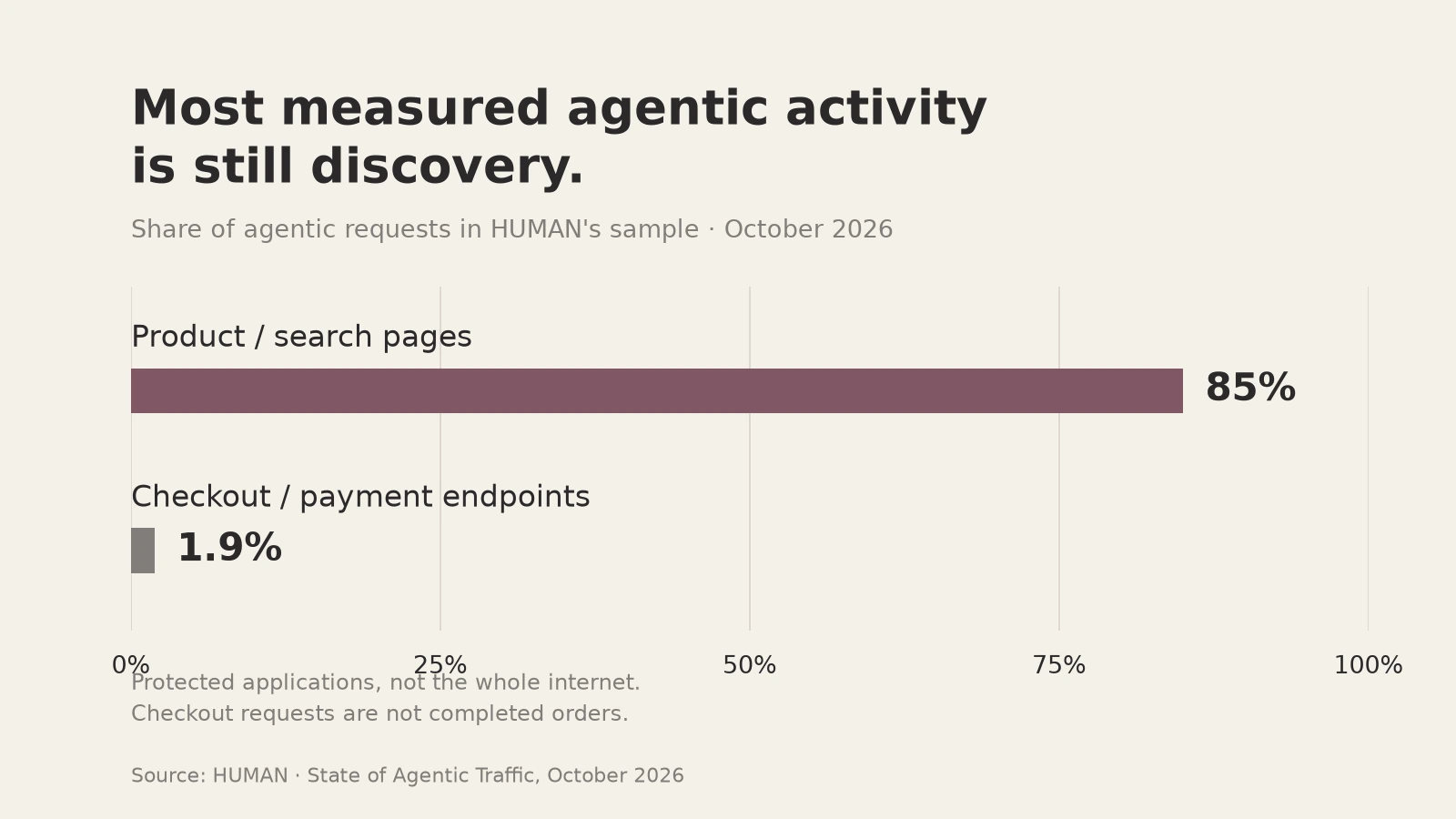
Source: HUMAN, October 2026. The comparison covers its protected applications, not the entire internet. Visiting a payment endpoint does not establish that a purchase happened.
For a supplier, the important part is that these tools are spending much more of their measured activity inspecting offers than reaching payment pages.
Your product information is part of that inspection. Whether or not you have bought a sales agent yourself.
Procurement is changing on the other side of the table.
This was also what stayed with me after the discussion between Daniel Vaarik and Pactum co-founder Kaspar Korjus at Estonia's AI Week.
The presentation showed an agent-supported procurement workflow beginning with a board meeting and a category strategy. Procurement rules then informed the purchase request, its checks and the tender documents. From there, the workflow moved to finding suppliers, requesting prices, negotiating, selecting a winner, preparing a contract and monitoring prices afterwards.
That is a much bigger change than putting a chatbot in the corner of a website.
The slides show a workflow, not proof that every decision should happen without human approval. Limits, authority and responsibility still have to be agreed. But look at what happens before a supplier gets the opportunity to negotiate.
The supplier first has to be found. Then its capabilities have to make sense against the buyer's requirements.
If the buyer needs a particular material, quantity, delivery window or certification, somebody's software may be checking those conditions before a salesperson gets a call.
There are operating examples too. In a January 2023 announcement, Pactum reported that its technology had reached agreements with 68% of the Walmart suppliers approached, with average savings of 3%. Those are vendor-reported results from the negotiations described, not 3% off Walmart's entire procurement budget. They still show that bounded, data-driven commercial negotiation is not a brand-new idea waiting for somebody to invent it.
Now consider the supplier's position.
You might have a good product. A capable factory. Twenty years of experience. Yet if a new buyer cannot establish whether you can do the job, none of those things automatically gets you into the comparison.
Your sales team may never know there was an opportunity.
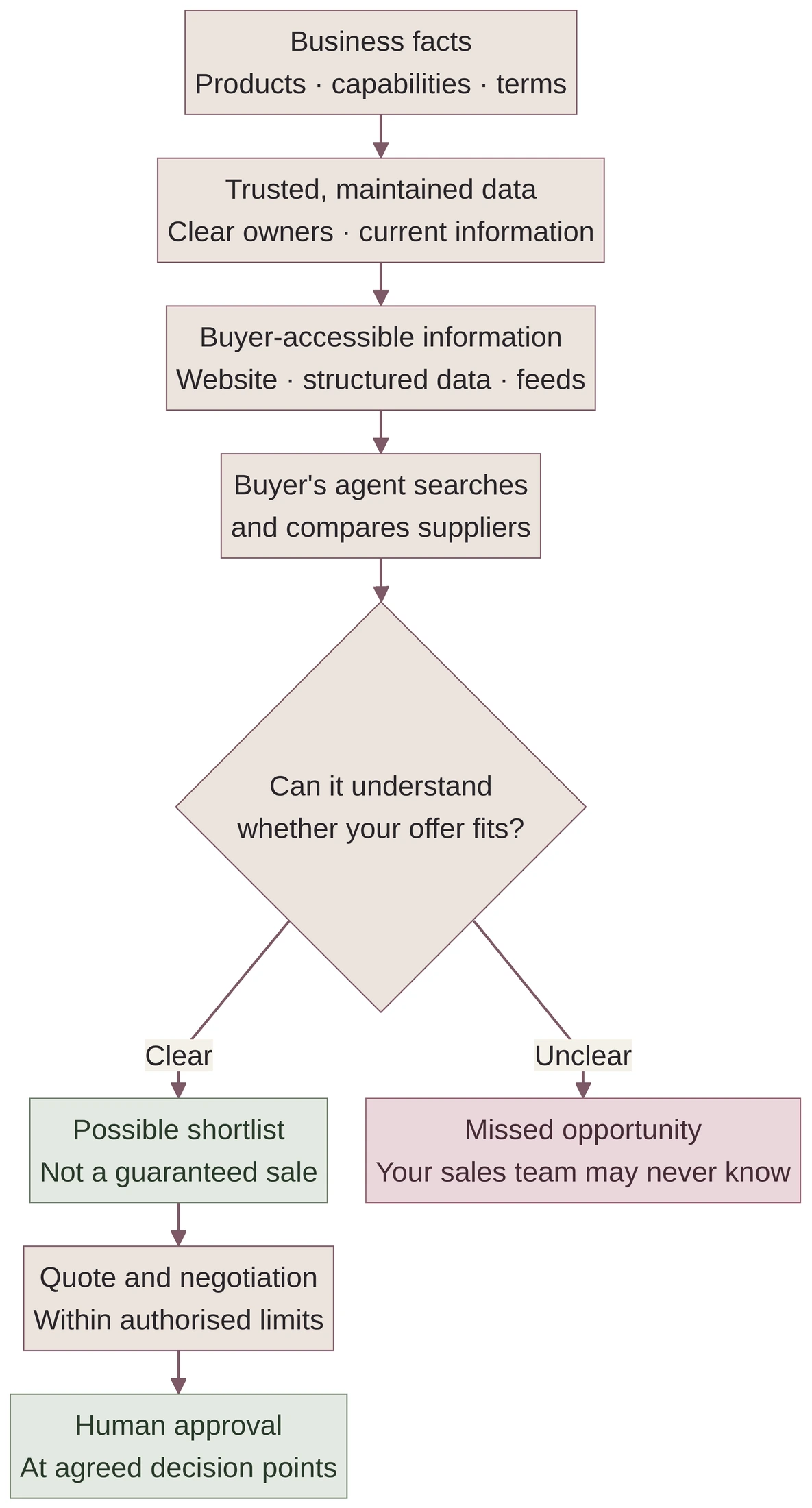
A simplified supplier-side view of discovery and procurement. Clear information makes an offer evaluable. It does not guarantee a shortlist position or a sale.
A product is not an offer until the conditions are understandable.
The second a16z article is useful because it looks beyond whether an agent can find a product name.
Its experiments explore how recommendations change when the request becomes more specific, when return terms differ, when a seller looks less trustworthy or when using the product requires an interface the agent cannot access. These are tests of selected tools and prompts, not universal laws about how every agent behaves.
But the practical questions are familiar.
What does the buyer actually need? What will the purchase cost after shipping? Can it be returned? Does the warranty apply? Can this seller deliver to the buyer's location?
A nice product description does not settle those questions.
The article's published checkout comparison makes the friction particularly obvious. With guest checkout, agents reached the checkout form in 50 of 62 runs, about 81%. Where an account was required, they reached it in none of 41 runs. That is a small experiment, and reaching a form is not completing a payment. But it identifies a concrete point where a possible purchase can stop.
The underlying problem is not that machines dislike your brand. It is that the path from finding an offer to being able to act on it can break.
Shopify's own guidance puts the responsibility in the right place: accurate product attributes, correct variant mapping, current prices and inventory, and business facts such as return-shipping responsibility. It also says catalogue inclusion does not guarantee placement or ranking.
And payment still requires authority. Stripe's announcement about Meta's Muse says consumers approve every transaction total in chat. Software helping a person buy something is not the same as software having unlimited permission to spend their money.
The offer has to be both understandable and usable. Those are separate jobs.
Access is only the beginning.
There is another shortcut I keep seeing: if the agent can open the website, we must be ready.
No.
A page can load successfully and still leave the tool without the information needed for a comparison. Conversely, an agent may find facts in ordinary text even when the structured fields are incomplete.
The point is not that AI can only read one particular markup format. It clearly cannot be reduced to that. The point is whether the right facts can be found and connected reliably to the right offer.
If you have hundreds of products, several variants, multiple languages and different sales partners, leaving every buyer's tool to reconstruct the catalogue is a pretty damn weak strategy.
The dimensions in the description need to match the dimensions in the feed. The available variant needs to match the image and the price. The stock status cannot mean one thing on the product page and another at checkout.
The same principle applies to a manufacturer that does not sell standard products online. A printing company cannot publish a fixed price for every possible job. But it can explain which materials, formats, quantities and finishing options it handles, and how to start a useful enquiry.
Nobody is asking the website to replace every commercial conversation.
It needs to provide enough information for that conversation to happen in the first place.
A credible provider starts by asking for your data.
Today I went through the onboarding process with a Swedish provider whose solution actually looked sensible. I had reviewed its materials earlier in the week and booked a call.
Our half-hour conversation turned into an hour. A real product. Real customer cases. They won me over.
But their work begins with the customer providing access to its product information management system, PIM, and product lifecycle management system, PLM. Alongside that, they want the existing product data, customer feedback, return volumes, Google Search Console data and other material that explains how the business and its products perform.
Those inputs do different jobs. Product records describe what the business sells. Reviews, customer-service questions and return reasons show what buyers misunderstood or could not establish. Search data shows how people describe the problem they are trying to solve.
Put them together and the task stops being “write a nicer description of this product”. It becomes “work out which real questions this product can answer, check the facts, and make those answers available”.
That matters when a buyer moves from typing a product name to asking for something that meets several conditions at once. Suitable for outdoor use. Compatible with an existing system. Available in a particular quantity. Delivered before a specific date.
The agent has to connect those conditions to the actual offer. A keyword in a title does not confirm suitability. A polished paragraph does not establish a delivery commitment.
Nor is the answer to generate a thousand plausible FAQs and hope some of them match. The answers have to come from validated product and business facts. Otherwise, we have improved the presentation of an unsupported promise.
If a brand cannot provide the required information, they will not even consider it as a potential customer. They know they cannot deliver the service properly without something to work with.
Compare that with the promises landing in my inbox.
This does not mean every small business needs to go out and buy a PIM and a PLM before doing anything useful. Those are this provider's requirements for its particular service. The broader lesson is that a credible supplier understands which information its service needs and checks whether that information exists.
It does not skip that question because the demo looks nice.
Data cleanup is not a one-off SEO project.
Data, data, data.
A very unpopular message. Nobody wants to hear that before trying the exciting new tool.
Yet this is also why handing the problem to marketing alone usually does not work. Marketing may write the page. Operations know the actual lead time. Product development knows which variants exist. Sales know the negotiated conditions. Somebody else owns stock.
Those people need a shared understanding of which information is authoritative and how changes reach the places where it is used.
Today a price changes. Tomorrow a product sells out. Next week a supplier sends a revised file. If the website, partner feed and internal system each keep a different version, one well-written AI description does not fix the problem.
Nor does adding llms.txt, buying a GEO package or switching on a connector. Those may have useful roles. None creates a reliable delivery promise or decides which of three contradictory prices is correct.
As I wrote in Don't Vibe Code in Between Sets, understand how the work actually moves through the business first. Then make the necessary information usable. Only then connect the automation to it.
There are also two different boundaries to respect. Information a buyer needs to assess an offer should be accessible in the appropriate channel. Confidential terms, customer correspondence and internal drawings do not all belong on a public website.
Likewise, giving an agent access to information is not the same as giving it authority to commit the company. Reading a file is not sending an email. Preparing a quote is not accepting a contract.
Good data and sensible permissions need to be designed together. Otherwise, we have merely made the wrong information easier to distribute or the wrong action easier to take.
Listen to the questions. Then fix the answers.
The next step is not simply to clean the catalogue once and declare victory. It is to keep learning which questions the existing information fails to answer.
Take a simple example: can a particular component be used outdoors? Its dimensions and price may be perfectly recorded, while the description says nothing about the finish or exposure limits. A relevant product can still leave the buyer unable to establish whether it fits.
The useful response is to ask the product owner, verify the conditions, and put the approved answer into the underlying product record. Then carry it through to the page, the relevant feed and the language versions where buyers need it.
After that, test whether the question is answered correctly. Watch what happens to relevant enquiries, purchases and returns. A click is useful information, but it is not the whole commercial result.
The same applies when customers repeatedly return something because the size, material or intended use was unclear. That is not just a customer-service problem. It is evidence that the offer may have set the wrong expectation.
AI can help group those signals, identify gaps and prepare changes. A person still has to confirm the facts and approve the promises. If the model proposes an answer nobody in the business can substantiate, it stays unpublished.
And when selling across markets, translating the same incomplete description into four languages only distributes the gap more widely. The wording should fit local buyers' questions without changing the product facts or commercial limits.
That is a useful feedback loop: learn what buyers need to know, verify it, improve the information, measure the result and repeat. Not endlessly manufacture more content.
What if we simply do nothing?
Recently, a marketing manager at a well-known Estonian manufacturer told me that everyone knows agents are coming and that something needs to be done. But the earlier SEO work is still unfinished. And the businesses in the worst shape have no resources to improve anything.
I found myself wondering whether people really sit in meetings discussing how to survive another year or two without doing the work.
It is a pretty ugly situation if that is the plan.
The pressure is not theoretical. On 25 November, Äripäev reported that furniture-component manufacturer Lumbester had filed for restructuring. Its last four reported quarterly turnover figures total €8,305,335, approximately €8.31 million. There is a real operating business behind the headline.
I am not claiming that poor data caused Lumbester's difficulties or that an AI agent would have saved it.
The wider commercial question is what happens when a company relies on two or three major customers and loses one. If new buyers cannot readily understand what the business offers, replacing that revenue becomes harder. A factory does not stop needing orders while management debates the next digitalisation project.
Doing nothing may feel harmless at first. Existing customers still buy. Salespeople still make calls. Distributors still place orders.
But hoping your distributors do all the work, and never replace your products with a cheaper Chinese brand, is not much of a strategy.
Neither is relying indefinitely on paid ads and old recommendations. Those channels can still work. The question is why you would leave another part of the buying journey unable to understand your offer.
This is part of the wider pressure on European producers and retailers. Even if external measures buy us time, they do not improve our product information, shorten our response time or explain our value to the next buyer. That work is still ours.
You can ignore AI. Your next buyer may not make the same choice.
Start with one commercial workflow. Not the next subscription.
I am not suggesting that every company needs a huge transformation programme before it can test anything.
Start small enough to finish. But start with the actual work.
-
Choose an important product group or capability. Take the part of the business where being found, compared or quoted matters commercially. A manufacturer might start with one production capability rather than its entire catalogue.
-
Find and reconcile the information. Establish the correct specifications, variants, prices or quoting conditions, availability and lead times. Where there is a contradiction, get the responsible person to resolve it. Do not ask the model to choose the version that sounds best.
-
Make the relevant facts accessible. Put buyer-facing information on the website and in the feeds or interfaces you actually use. Test the ordinary page as well as the structured data. Keep internal and confidential information behind the right controls.
-
Test a real buyer's question. Ask different tools to find a suitable offer without supplying your company name or URL. Check whether they find you, understand the relevant variant and lead to a useful next step. A single successful answer is not a permanent guarantee; use repeatable checks.
-
Then run a bounded agent pilot. Let it help with one task, such as extracting an enquiry, checking specifications or preparing a first quote. Measure whether correct quotes go out faster, whether less time is spent chasing information and whether the buyer can proceed more easily. Agree which actions need human approval.
AI can help with the groundwork as well as the pilot. The order is not “do everything manually, then earn permission to use AI”. It is “use the tools to establish a reliable basis before promising results from the automation”.
You may not even need another programme. As I wrote about software that executes work rather than making people operate more tools, start by testing a task where the information already lives. Buy the additional tool when there is a reason for it.
That is a much more useful conversation than asking which agent is currently the smartest.
I am interested in better sales. Not selling you an agent.
The opportunity here is real. We can process more information, compare more offers and reduce a lot of the repetitive work around buying and selling.
That is also the point behind my question about Estonia's equivalents of Furniture1 and BURGA. A manufacturer does not need to become a software company. It needs to use technology to sell good products to more customers, internationally.
But the four hours of work do not always disappear. Often, those same four hours let us investigate more thoroughly and arrive at a better result.
That is what interests me. Not producing more slop faster. Not installing something that lets everyone say they have an AI project.
If you want to understand where your business stands, send me your website. If a particular product group or export market matters, tell me that too. I can do a quick review of the public information and point out the concrete gaps.
Free. No strings attached. No assumption that we have to take another step together.
And if there is a sensible next step, we can discuss it separately.
But I am not going to sell you an agent and pretend it replaces the work.

Hands-on product, business and AI leadership for executives of established companies. Working on agentic commerce through OfferSignal.
About Sander